
Table of Contents
A lot of people find out about their color vision deficiency for the first time at their FAA medical exam. One minute you’re on track toward your pilot certificate, and the next you’re staring at a plate of dots that just don’t make sense.
Here’s the thing though: failing the FAA color vision test in Florida does not automatically end your flying career. The Ishihara is only one of the tests and the FAA offers a clear procedure for pilots who fail the test. This guide will show you the steps to take and what options you have and how you can ensure you have the best chance to remain at the controls.
It’s a great time of year for student pilots to move ahead in their flight training. If you’ve experienced this during a recent medical examination you’re not alone and you’re not without possibilities.
What Is the Waggoner Color Vision Test?
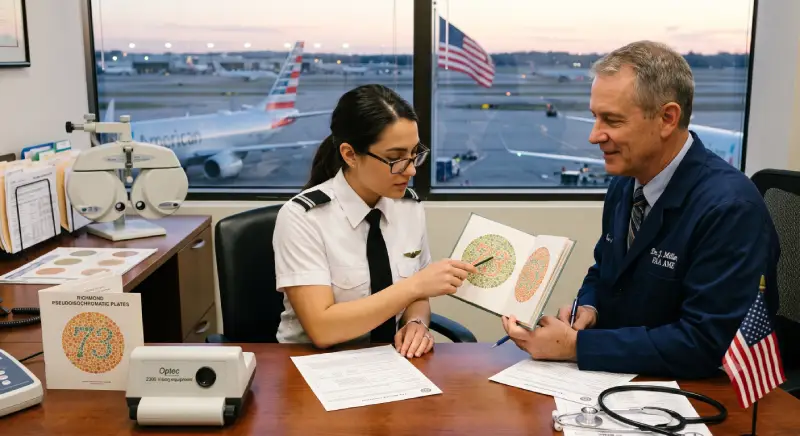
Ishihara test provides a set of numbered plates composed with colored dots. It is the most frequently employed screening tool to detect the deficiency of color vision in FAA medical examinations. Your Aviation Medical Examiner (AME) will require you to recognize the patterns or numbers hidden in the plates.
It screens for primarily red-green color deficiencies which is the most frequent kind. The FAA utilizes it since the ability to recognize colors is crucial in aviation. Reading runway lights and understanding sectional charts as well as identifying lights for aircraft positions all depend on the ability to distinguish hues accurately.
What Happens When You Fail the Ishihara?
Failing the Ishihara does not mean an automatic disqualification. Here’s what actually happens:
- Your AME notes the failure on your medical exam
- You are not issued a standard color vision statement on your medical certificate
- You are then eligible to pursue an alternative test or a waiver
- You can still fly while this process is underway in many cases (depending on your certificate type)
The key point: the Ishihara is a screening tool. The FAA recognizes that some pilots who do not pass the Ishihara screening test may still demonstrate sufficient color recognition through other approved testing methods.
Your Options After a Failed FAA Color Vision Test in Florida
Option 1 Take an Alternative Color Vision Test
This is the most common next step. The FAA accepts several alternative tests that are more nuanced than the Ishihara. If you pass one of these, you can receive a color vision statement on your medical certificate. For a deeper explanation of why the FAA allows this, see why the FAA allows multiple color vision tests like Rabin and CAD for pilots.
Option 2 Operational Color Vision Test (OCVT)
If you can’t pass any of the alternative tests, you may be eligible for an Operational Color Vision Test. This is a real-world evaluation where you’re tested on your ability to identify aviation-specific signals and lights in an actual operational setting.
Explore Your FAA Color Vision Options
Our specialized testing helps pilots find the best path toward FAA medical certification.
Does the Type of Color Deficiency Matter?
Yes. There are different types of color vision deficiency, and not all of them affect aviation performance equally.
- Deuteranomaly (reduced green sensitivity) — most common; many pass alternative tests
- Protanomaly (reduced red sensitivity) — slightly less common; still good alternative test options
- Deuteranopia / Protanopia (complete absence of green or red cones) — more significant
- Tritanomaly / Tritanopia (blue deficiency) — rare; FAA evaluates case by case
The specific type you have affects which alternative tests you’re likely to pass. This is where getting tested at a facility that offers multiple options and knows how to guide you through the process.
Why the Right Testing Facility Matters
Not every AME offers all of the FAA-accepted alternative tests. Some only have the basic Ishihara plates. If you failed the Ishihara and want to pursue alternatives, you need to go somewhere specifically equipped for color vision testing.
Pilot Color Vision Testing was built exactly for this situation. Dr. Weinberg is a Senior HIMS Aviation Medical Examiner who has invested significant time and resources into creating a facility that maximizes every pilot’s chance of qualifying. He offers multiple alternative FAA-accepted color vision tests under one roof and guides pilots through the process from start to finish.
For Florida pilots who have failed the FAA color vision test, this kind of specialized support matters more than a general AME visit.
A Quick Checklist: What to Do After Failing the Ishihara
- Don’t panic, the process is not over
- Ask your AME which alternative tests are available at their office
- If they don’t offer alternatives, find a facility that does
- Know your color deficiency type if possible (an eye doctor can confirm)
- Bring any prior color vision records or documentation to your next appointment
- Ask specifically about the FALANT and Cone Contrast Test both have solid pass rates for mild to moderate deficiencies
Where to Get Tested in Florida
For pilots in Florida, Pilot Color Vision Testing offers the full range of FAA-accepted alternative color vision tests. Dr. Weinberg understands the FAA medical certification process deeply and works with each pilot individually to find the best testing pathway.
You can find more information about the FAA’s color vision standards at the FAA’s official Civil Aerospace Medical Institute page.
Conclusion
A failed FAA color vision test in Florida is not a dead end. It’s a detour and in many cases, a pretty short one. The FAA has built in multiple pathways specifically because they recognize that color deficiency doesn’t automatically make someone an unsafe pilot. If you decide to take an alternative test there’s a good chance you’ll still be able to get the certificate you need and be flying.
The most important thing is to know your options and then going to the right location to look them up. If you’ve recently failed the FAA color vision test, don’t wait, the sooner you start the alternative testing process, the sooner you get clarity on your path forward.
Frequently Asked Questions
What happens if you fail the Ishihara test for FAA medical?
Your AME notes the result and you won’t receive a standard color vision statement on your certificate. From there, you can pursue alternative FAA-accepted tests, an operational evaluation, your aviation journey isn’t over.
What are the alternative FAA color vision tests?
The FAA accepts several alternatives including the Farnsworth Lantern (FALANT), Optec 900, Keystone Orthoscope, CVAA, and the Cone Contrast Test. Many pilots who fail the Ishihara pass one of these without difficulty.
Can I still fly even if you fail to pass an FAA testing for color vision?
Yes, in a lot of cases. Based on the type of your certificate and the result of other tests, you can travel without restrictions or with a limit on daytime flights.
Where can I get to take a different FAA testing for color vision in Florida?
Pilot Color Vision Testing, operated by Dr. Weinberg, offers multiple FAA-accepted alternative color vision tests in Florida. It’s a facility built specifically to give pilots the best possible chance of qualifying.
Don't Give Up on Flying
At Pilot Color Vision Testing, Dr. Weinberg’s entire focus is helping pilots navigate the FAA medical certification process including color vision challenges. As a Senior HIMS Aviation Medical Examiner, he has the experience, the equipment, and the genuine commitment to give every pilot a fair shot.
If you’ve failed the Ishihara and want to explore your options, schedule your color vision evaluation today. Contact us at Pilot Color Vision Testing through aweinberg@medavex.org (561) 248-4627 to set up your appointment