
Can someone with color blindness become a pilot? What about the situation when you need to wear glasses in order to distinguish some colors? And can such glasses help during your FAA medical examination?
These are typical concerns for people with a color vision deficiency who want to become pilots. It is clear that color perception is significant in terms of aviation because pilots have to distinguish colored lights, read maps, etc. However, it should be noted that color blind glasses for pilots do not mean the method approved by the FAA in order to correct your color vision deficiency. It is essential to distinguish between these two concepts prior to undergoing the medical check-up.
This guide will help you understand how pilots’ color blindness works, why people use corrective glasses, what kind of FAA testing is done, and what alternatives are possible if the first attempt fails.
What Is Color Blindness and How Does It Affect Pilots?
Color blindness, more appropriately referred to as color vision deficiency, refers to an individual having problems differentiating certain colors or shades. The red-green color deficiency is the most prevalent, whereas blue-yellow is the least prevalent form. Complete color blindness is rare.
For everyday life, a mild deficiency may cause relatively few problems. Aviation can be different because color can carry important information.
A pilot may need to:
- Recognize red, green, and white aviation lights
- Interpret color-coded cockpit information
- Read aeronautical charts
- Distinguish visual signals and indicators
- Identify colors needed for specific flight-related tasks
For someone with color vision deficiency, it is natural to wonder whether anything can make these colors easier to distinguish. This often leads to the question: can pilots wear color blind glasses?
The FAA requires pilots to be able to perceive the colors necessary for the safe performance of their airman duties. While color-correcting glasses may change how certain colors appear, they do not replace the FAA’s color vision requirements.
Why Do Pilots Consider Color Blind Glasses?
Color-correcting lenses are meant to distort the wavelengths of light that enter the eye. It might filter selected parts of the spectrum of light so that certain color-some hues may be rendered much more contrasted for a person with specific types of color vision deficiency.
That is why someone struggling with color discrimination may search for color correcting glasses for pilots.
However, there are two separate questions:
Question | What it means |
Do the glasses affect my perception of colors? | They might enhance the perceived difference of colors for particular individuals. |
Will the FAA certify me using them? | The FAA does not approve the use of color correction lenses to compensate for a pilot’s color vision deficiency. |
In other words, enhanced perception of colors in real-life situations is not the same thing as passing the FAA’s test.
Do Color Blind Glasses Work for Pilots?
There are variations in the outcome for each individual. The nature and degree of color blindness in addition to the specific lenses that are worn will have an impact on the user’s experience.
Do EnChroma Glasses Work for Pilots?
EnChroma glasses are engineered to change light transmission of certain wavelengths and could enhance the visibility of certain colors to some users.
This does not necessarily mean that they correct color blindness or that they automatically meet an aviation medical requirement.Someone researching EnChroma glasses FAA pilot requirements should separate everyday visual improvement from FAA certification.
What About X-Chrom Contact Lenses?
X-Chrom lenses are another color-vision-correcting option that pilots may encounter when researching aviation and color blindness.
The FAA specifically states that color-vision-correcting lenses such as X-Chrom are not acceptable as a means of correcting a pilot’s color vision deficiency for FAA purposes.
Are Color Blind Glasses Allowed During an FAA Medical Exam?
This is one of the most important points to understand.
Color-correcting lenses cannot be relied upon to pass the FAA color vision screening. This applies to specialized glasses and contact lenses intended to alter color perception.
That is different from ordinary prescription glasses used to correct problems such as nearsightedness or farsightedness.
So, if you are asking, can you pass the FAA color vision test with glasses, the answer depends on what type of glasses you mean. Standard prescription correction and color-correcting lenses are not the same thing.
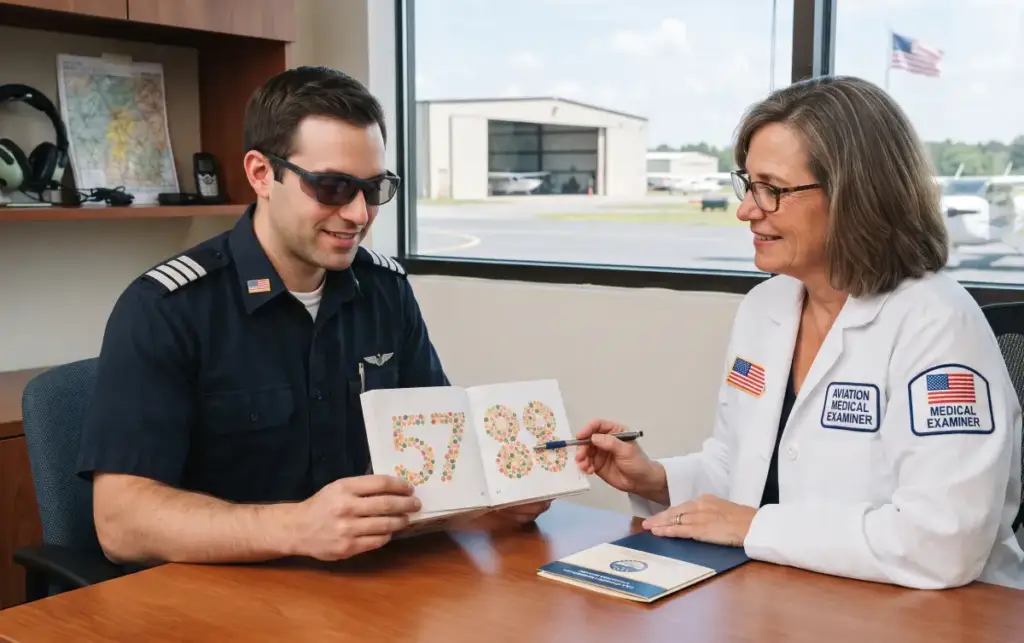
Have Questions About FAA Color Vision Testing?
The Pilot Color Vision Center offers in-person CAD, RCCT, and Waggoner testing for pilots and aspiring pilots.
What Should Pilots Know About FAA Color Vision Testing?
The FAA’s color vision requirement is based on whether an applicant can perceive the colors necessary for safe airman duties. The process used to evaluate this has also changed.
Beginning January 1, 2025, applicable pilot examinations use approved computerized color vision testing performed in person.
The FAA currently recognizes three computerized options:
FAA-approved test | What it evaluates |
CAD | Color discrimination using controlled visual signals |
RCCT | Red, green, and blue cone contrast |
Waggoner | Different types of color vision deficiency through computerized testing |
An AME may have one or more of these tests available. If the appropriate test is not available at the office, the applicant may be directed to another location.
What About Older Color Vision Tests?
Pilots may still find older information mentioning tests such as:
- Farnsworth Lantern
- Farnsworth D-15
- Yarn testing
- OPTEC 5000
- Older signal-light testing procedures
These should not automatically be treated as current FAA screening options. The current FAA guidance specifies which computerized tests are accepted, including the RCCT pilot test.
The same applies to online, printed, or downloaded color vision tests. They may be useful for personal information, but they are not a replacement for the official FAA evaluation.
What Happens During the FAA Color Vision Examination?
The practical process is fairly straightforward.
Before the appointment
- Schedule your medical examination with an FAA Aviation Medical Examiner.
- Tell the AME if you already know that you have a color vision deficiency.
- Ask which approved test is available.
- Bring relevant medical information if applicable.
During the appointment
The color vision screening is completed in person using the approved testing method available at the examination. If a CAD test pilot option is available, you will receive instructions for completing the computerized assessment, and the result becomes part of your medical examination.
After the test
If you are able to meet the applicable color vision requirement, then the color vision section of the exam may be completed.
However, if you do not meet the requirement, then the next course of action will depend on your particular situation and experience with obtaining your medical certificate.
What Happens If You Fail the FAA Color Vision Exam?
A failure on the initial exam does not necessarily mean that you will never be able to become a pilot.
There are special provisions outlined by the FAA that permit certain restrictions when obtaining a medical certificate if you fail one of the approved tests in the examination process and you are otherwise qualified.
For instance, a Third-Class medical certificate with only a day VFR limitation may be issued under applicable conditions.
The results will vary based on whether you have a medical certificate or need a higher class.
Can You Take Another Approved Test?
For a first-time applicant, the FAA allows any or all of the approved tests available at the examination to be attempted. If the AME does not have an approved test available, testing may be completed at another location and the results provided to the AME.
This is why it is worth discussing the situation with the AME before assuming that one unsuccessful test is the end of the process.
What Options Are Available After an Unsuccessful Screening?
Some pilots may have additional FAA evaluation pathways available depending on their circumstances.
Operational Color Vision Test (OCVT)
An OCVT is an operational evaluation rather than another computerized screening. It can involve practical tasks such as identifying aviation signal colors and reading aeronautical charts.
Medical Flight Test (MFT)
A Medical Flight Test is another type of operational evaluation that may be relevant to certain applicants seeking an applicable certification pathway.
These evaluations are different from simply using color-correcting lenses. If you are researching X-Chrom lens FAA requirements, the FAA does not accept X-Chrom or similar color-correcting lenses as a means of correcting color vision deficiency for certification.
Can You Still Become a Pilot If You Are Color Blind?
The issue of being diagnosed with color blindness does not say much about what will actually happen to your pilot’s medical certificate.
In any case, the most important thing is whether you satisfy the color vision standards of the FAA and, if not, whether there is a certification procedure applicable to your case. Pilots also often ask, do EnChroma glasses work for pilots, but using color-correcting glasses is not the same as meeting the FAA’s certification requirements.
The best advice for those who think about starting their careers in aviation is to learn the requirements beforehand and not to wait for problems at a medical check-up.
How to Prepare for Your FAA Color Vision Exam?
You do not need to train your eyesight for weeks before the FAA exam. You just have to know how the process goes.
Be aware of your background. In case there was any diagnosis of color vision deficiency in your past, be aware of all the details regarding it.
Consult with an AME. Before taking the test, ask questions concerning color vision, if needed.
Arrange for the test. Find out which approved test is available at the practice.
Bring relevant documentation. Keep previous medical or vision information available if it may be useful.
Know your options. Failure to pass the test means that you should inquire about any other tests or evaluations required.
Where Can I Get an FAA Color Vision Test in West Palm Beach?
If you are searching for an FAA color vision test in West Palm Beach, get in touch with an FAA Aviation Medical Examiner and inquire about the computerized test being offered.
Before booking, confirm:
- Which approved test is available
- Whether the test is performed in person
- Whether the office handles applicants seeking your particular medical certificate
- What documents you should bring
Whether or not there is another place that provides the test if the needed test is not provided there
This information can save you from wasting your time, making your appointment easier to organize.
Common Myths About Color Blind Pilots
“Color blind pilots cannot fly.”
That is too broad. The FAA evaluates whether a pilot meets its color vision requirements, with additional pathways available in some cases.
“FAA color correcting lenses are allowed during the test.”
This is a common question for pilots: are FAA color correcting lenses allowed during the color vision test? No. Color-correcting lenses do not replace the FAA’s required color vision evaluation.
“Failing one test means my aviation career is over.”
Not automatically. Further testing or evaluation may be possible, depending on the applicant’s circumstances.
“An online color vision test counts as an FAA test.”
It does not. The Waggoner Computerized Color Vision Test is an FAA-accepted test performed as part of the official screening process.
Get Clear on Your FAA Color Vision Options
Colorblind glasses may assist certain individuals in discerning color better, but they should never be regarded as an easy way to bypass the medical procedure of the FAA. For color blind glasses aviation medical questions, the key is understanding what the FAA actually accepts for certification.
The Pilot Color Vision Center, led by Auren Weinberg, MD, MBA, provides FAA-acceptable color vision testing using the Waggoner, Rabin Cone Contrast, and CAD tests. The center focuses specifically on helping current and prospective pilots navigate color vision certification.
Preparing for an FAA Pilot Color Vision Test? Contact the Pilot Color Vision Center to discuss your testing options and next steps.
Call: (561) 248-4627
Email: aweinberg@medavex.org
FAQs
Can pilots wear color blind glasses while flying?
Do color blind glasses help with FAA color vision requirements?
What should I do if I cannot pass an FAA-approved color vision test?
Talk to the AME about the results and what additional testing or limitation or evaluation pathway might apply.
Can pilots with color vision deficiencies be eligible for an FAA Medical Certificate?
The answer depends on the individual’s testing results, medical certificate, and applicable FAA pathway.
Can I retake an FAA color vision test after failing the first one?
A first-time applicant may attempt any or all approved tests available during the examination. Another testing location may also be possible when an AME does not have an approved test available.